China’s August retail sales miss forecast as investment slump deepens

Pedestrians pass an Apple Inc. store in the Wangfujing shopping area in Beijing, China, on Friday, Feb. 10, 2023. China’s consumer inflation accelerated last month as the country reopened and the Lunar New Year holiday spurred demand, although gains remain muted enough for the central bank to keep easing monetary policy to support the economy’s recovery. Source: Bloomberg
Bloomberg | Bloomberg | Getty Images
China’s investment slump deepened and retail sales growth slowed further in August, while industrial output topped estimates with authorities warning of acute supply-demand imbalance at home.
Retail sales grew 0.4% in August from a year earlier, data from National Bureau of Statistics showed on Tuesday, slowing from 0.6% in the prior month and missing economists’ forecast for a 0.8% growth in a Reuters poll.
Industrial output expanded 5.2% last month, accelerating from 4.5% growth in July and outperforming economists expectations for a 4.8% rise.
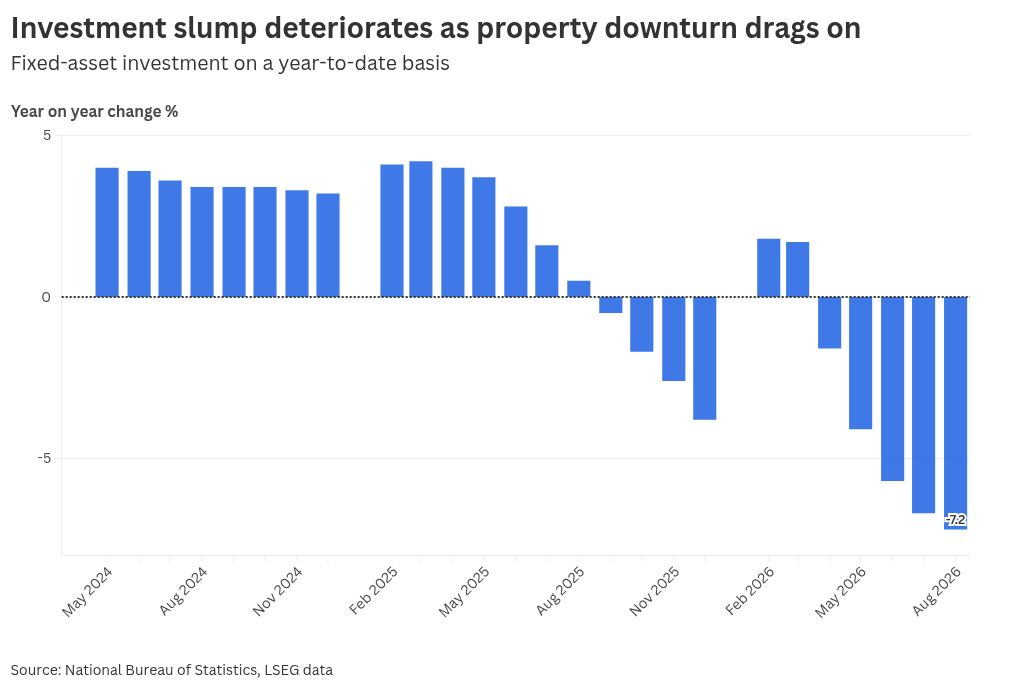
For the first eight months of the year, urban fixed-asset investment, which covers property and infrastructure investment, shrank 7.2% from a year earlier, steepening from 6.7% decline in the January-to-July period, matching analysts’ expectations.
The urban survey-based unemployment rate in August ticked up to 5.3% from 5.2% in July, and unchanged from the same period last year.
NBS spokesperson Fu Linghui attributed the uptick in unemployment to the graduation season, while highlighting stable employment in manufacturing, good prospects for tech jobs and growth in the hospitality and catering sectors.
“We should be aware that the adverse impact of (the) external environment has intensified,” the statistics bureau said in an English-language release. It noted “acute” imbalance domestically between “strong supply and weak demand,” adding that some businesses still faced operational difficulties.
In the statement, the NBS called for stepping up macro-policy adjustments and boosting domestic demand, while advancing industrial upgrades for “innovation-led” development.
While growth in the world’s second-largest economy slowed to 4.3% in the second quarter, the weakest pace in more than three years, policymakers have so far resisted more aggressive stimulus, relying instead on incremental measures to shore up growth.
Veering further from target
“The market is waiting for the fiscal policy to become more supportive in Q3,” said Zhiwei Zhang, president at Pinpoint Asset Management, after tepid growth in the second quarter. He expects the economy to continue facing downside risks as fiscal support takes time to take effect.
Beijing has stepped up government bond issuance and expanded loan-interest subsidies for small private businesses and consumers in recent weeks, while the central bank has pledged more policy support without signaling an explicit rate cut.
Efforts to fire up appetite for new debt have, however, fallen short. China’s credit expansion in August missed forecasts by a wide margin, with government bond financing unable to offset sluggish corporate and household demand. New bank loans expanded by just 60 billion yuan ($8.95 billion), versus a roughly 400 billion yuan forecast and down from 590 billion yuan a year earlier, while outstanding loan growth slowed to a record-low 4.9%.
Oxford Economics estimates third-quarter growth at 4.3%, posing downside risks to its 4.7% annual growth target and veering further from Beijing’s annual target of 4.5% to 5%. Weak consumption and the property slump remained the biggest drags on growth, even as exports and high-tech manufacturing added some momentum, it added.
A team of economists led by Raymond Yeung, China economist at ANZ Research, said in a note earlier this month that “September could represent an important policy window to revive business confidence ahead of October’s Golden Week holidays.” More fiscal support is needed, but a policy rate cut remains unlikely, they added.
Analysts, however, expect that Beijing is unlikely to ramp up stimulus meaningfully as long as export growth remains strong enough to power the economy to land within the target range.
A global investment boom in artificial intelligence has lifted demand for Chinese semiconductors and tech hardware. The country’s massive oil stockpiles have also offered a further buffer against surging energy prices, allowing the world’s biggest crude importer to scale back oil purchases. China’s official manufacturing purchasing managers’ index showed new orders and output both returned to expansion in August after contracting in July.